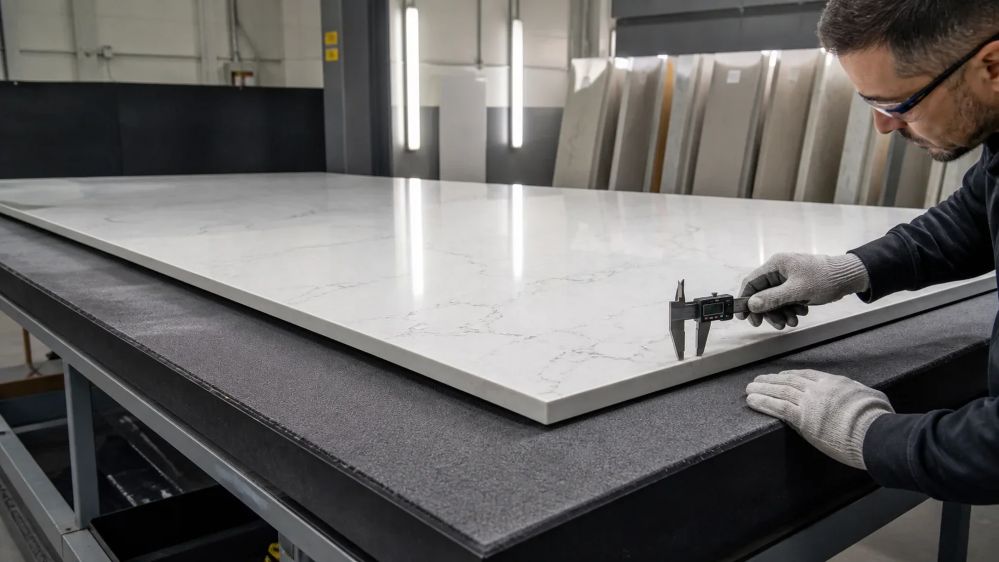
Quartz countertops are valued for their durability, consistent appearance, and relatively low maintenance requirements. However, the quality of a finished countertop depends on more than the material itself. Understanding quartz countertop fabrication specifications helps homeowners, contractors, designers, and fabricators make informed decisions about slab selection, measurements, edge profiles, seams, cutouts, and installation requirements.
For manufacturers and industry professionals such as Hyundai L&C, maintaining clear fabrication standards is essential to achieving reliable results across residential and commercial projects. Even small measurement errors or incorrect handling procedures can affect the finished appearance, structural integrity, and long-term performance of a countertop.
Understanding Quartz Countertop Fabrication Specifications
Engineered quartz countertops are manufactured using natural quartz particles combined with polymer resins, pigments, and other materials. The resulting slabs offer consistent patterns and a range of colors, making them suitable for kitchens, bathrooms, and other interior applications.
Fabrication specifications establish the technical requirements for turning these slabs into finished countertops. They typically address:
- Slab dimensions and thickness
- Measurement and templating accuracy
- Cutting and edge finishing
- Seam placement and joining methods
- Sink, faucet, and appliance cutouts
- Support and installation requirements
- Handling, storage, and transportation
Following the manufacturer’s technical documentation is important because specifications can vary by product, thickness, slab construction, and intended application.
Key Dimensions and Thickness Requirements
Slab thickness is one of the first considerations during countertop fabrication. Common engineered quartz thicknesses include approximately 2 cm and 3 cm, although availability varies by product line and manufacturer.
Each thickness has different fabrication and installation considerations.
2 cm quartz slabs: These provide a relatively lightweight option for countertops. Depending on the application and product requirements, they may need additional substrate support or a built-up edge to achieve a particular finished appearance.
3 cm quartz slabs: These provide greater material thickness and can create a substantial countertop profile. They are frequently selected for kitchen countertops and islands where a thicker visual appearance is preferred.
Fabricators should confirm the actual slab thickness rather than relying exclusively on nominal measurements. They should also consider finished dimensions, cabinet heights, overhangs, and transitions between adjoining surfaces.
Accurate measurements help prevent unnecessary material waste and reduce the likelihood of installation adjustments.
How to Measure and Template Quartz Countertops
Precise templating is essential for producing countertops that fit correctly. Before cutting begins, fabricators need accurate measurements of the cabinets, walls, appliances, sinks, and other relevant features.
A professional templating process should account for:
- Cabinet dimensions: Confirm that cabinets are level, properly secured, and positioned according to the installation plan.
- Wall irregularities: Measure variations in wall alignment, corners, and adjoining surfaces.
- Overhang requirements: Establish the intended countertop projection and determine whether additional support is necessary.
- Appliance clearances: Account for cooktops, ranges, refrigerators, and other equipment that may affect countertop dimensions.
- Sink placement: Verify the sink model, mounting method, and required opening dimensions.
Digital templating systems can help capture complex layouts and reduce manual measurement errors. However, the information must still be reviewed before fabrication.
Templates should reflect actual site conditions. Measuring before cabinets are fully installed or assuming walls are perfectly straight can result in costly fitting problems.
Quartz Countertop Fabrication Specifications for Cutting
Cutting engineered quartz requires suitable equipment, correct tooling, and controlled working conditions. Quartz is a hard material, so inappropriate cutting methods can cause chipping, edge damage, or cracks.
Professional fabricators commonly use water-fed bridge saws, CNC machinery, and diamond tooling designed for stone fabrication.
Several considerations influence cutting quality:
- Blade selection: Use tooling appropriate for engineered quartz and the manufacturer’s fabrication recommendations.
- Cutting speed: Follow equipment and tooling guidelines to avoid excessive heat and material stress.
- Slab positioning: Ensure the slab is adequately supported throughout the cutting process.
- Cutting sequence: Plan cuts to minimize unnecessary handling and reduce the risk of damage.
- Water management: Use appropriate water-fed cutting methods to control dust and heat.
Dry cutting and uncontrolled grinding can release respirable crystalline silica, which presents a serious occupational health hazard. Fabrication facilities should follow applicable workplace safety regulations and use appropriate engineering controls, including wet processing and suitable dust extraction systems.
Edge Profiles and Finishing Requirements
The countertop edge influences both the finished appearance and practical usability of the surface. Different profiles create different visual effects, but the selected design must also be compatible with the slab thickness and fabrication requirements.
Common quartz countertop edge profiles include:
- Eased edge: A simple, slightly softened edge with a clean and contemporary appearance.
- Bullnose edge: A rounded profile that creates a softer transition.
- Beveled edge: An angled finish that adds definition without an overly decorative appearance.
- Ogee edge: A more detailed profile often selected for traditional interior designs.
- Mitered edge: A fabrication technique that joins angled pieces to create the appearance of a thicker countertop.
Edge finishing requires careful grinding and polishing. Fabricators should maintain consistent profiles, avoid excessive material removal, and inspect finished edges for chips, unevenness, and visible imperfections.
Not every profile is appropriate for every quartz product. The manufacturer’s technical guidance should determine which fabrication methods are acceptable.
Seam Placement and Joining Techniques
Seams are sometimes unavoidable when countertops extend beyond the available slab dimensions or include complex layouts. Their location and quality can significantly influence the finished installation.
Whenever possible, seams should be positioned in less prominent areas while maintaining structural and practical requirements.
Important seam considerations include:
Color and pattern alignment: Select adjoining pieces carefully to create a visually consistent transition. Pattern direction and color variation can affect how noticeable a seam becomes.
Edge preparation: Joining surfaces should be properly cut, clean, and aligned before adhesive application.
Adhesive compatibility: Use a suitable adhesive recommended for the quartz product and intended application.
Clamping and curing: Follow the adhesive manufacturer’s instructions for clamping pressure, curing time, and working conditions.
A well-executed seam should have consistent alignment, minimal visible gaps, and a clean finish. However, the natural appearance of the material, lighting conditions, and pattern characteristics can influence seam visibility.
Sink, Faucet, and Appliance Cutout Specifications
Cutouts require particular attention because they interrupt the continuous structure of the countertop. Incorrect dimensions, sharp internal corners, or inadequate support can increase the risk of cracking.
Fabricators should verify the manufacturer’s installation template for every sink, cooktop, and other integrated fixture before cutting.
Key requirements include:
- Confirming the exact dimensions of the fixture.
- Following the specified corner radii for internal cutouts.
- Avoiding sharp internal corners that can concentrate stress.
- Providing adequate support around openings.
- Finishing and inspecting all exposed cutout edges.
- Maintaining required clearances from slab edges and nearby seams.
Cooktop openings may also require specific clearances and heat-related installation precautions. These should be checked against both the countertop manufacturer’s documentation and the appliance manufacturer’s instructions.
Support, Overhangs, and Installation Considerations
Proper support is essential to the performance of a finished quartz countertop. Even a well-fabricated slab can develop problems if the cabinets, substrates, or support structures are inadequate.
Overhangs deserve particular attention, especially on kitchen islands and breakfast bars. The amount of unsupported projection permitted depends on factors such as slab thickness, countertop geometry, loading conditions, and manufacturer requirements.
Before installation, professionals should verify:
- Cabinet stability and levelness.
- Support requirements beneath the slab.
- Reinforcement around sink and cooktop openings.
- Appropriate support for extended overhangs.
- Compatibility of installation adhesives and materials.
- Proper handling during lifting and positioning.
Countertops should be transported and installed using appropriate lifting equipment and handling procedures. Twisting, bending, or unevenly supporting a slab can introduce stresses that increase the possibility of breakage.
Quality Control Before Final Installation
A systematic inspection helps identify fabrication problems before the countertop reaches the installation stage.
A final quality-control checklist should include:
- Confirming finished dimensions against approved templates.
- Inspecting the surface for visible damage, chips, and scratches.
- Checking edge profiles for consistent finishing.
- Reviewing seam alignment and adhesive application.
- Verifying cutout dimensions and edge conditions.
- Confirming that the required support components are included.
- Checking that the finished pieces are correctly labeled and ready for installation.
Fabricators should also document any deviations from the original specifications and obtain approval before proceeding with changes that could affect the finished result.
Making Better Decisions With Quartz Fabrication Standards
Understanding quartz countertop fabrication specifications helps ensure that countertops meet the practical and visual expectations of a project. Slab thickness, accurate templating, appropriate cutting methods, carefully finished edges, properly positioned seams, and adequate structural support all contribute to a successful installation.
Rather than treating fabrication as a simple cutting process, homeowners and industry professionals should recognize it as a series of technical steps that require material knowledge and careful workmanship. Reviewing manufacturer-specific documentation before fabrication begins is one of the most effective ways to reduce errors, protect material quality, and achieve consistent results.
When selecting engineered quartz for a residential or commercial project, working with knowledgeable suppliers and experienced fabricators makes it easier to understand product requirements and choose suitable surface solutions. Hyundai L&C offers quartz surface options for projects where material quality, design consistency, and reliable fabrication guidance are important considerations.